PERSONAL PROFILES
B to B
To navigate the Personnel section, all veterans are grouped alphabeticaly by the first letter of their last name. Click on the links listed above to take you to the correct alphabetical group. Using the scroll bar on the left, scroll down through the list of names contained within this left border then click on the one you wish to see. Alternatively, you can use the scroll bar on the right and scroll down through all the personnel listed on this page.
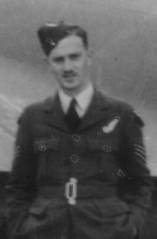
 Sgt ?? Bagguley
Sgt ?? Bagguley, Pilot Blenheims
The following was provided by Corp Stan Harrison via Jim Newton. "Sgt Bagguley was a pilot [ a good one] and he came from Carnforth, Lancashire, not far from where Stan came from. Also remembered by Corp (S/Ldr) Ian Blair in a chat with Stan in 2007. Stan recalls flying with him in a Blenheim to a dispersal field to recover some small bombs that had fallen from a Blenheim when it landed heavily."
Listed in S/Ldr Keily log as having flown with him June 1939
(CLICK ON NAME FOR PERSONAL PAGE)
F/Sgt Alan Bailes, WOP/Ag Egypt, Burma
My crew, pilot F/Sgt Bill (Victor William) Hinds, Observer F/S John Aitken and myself were posted from No 6 Squadron in the Middle East in January 1942. When we reached Rangoon we were not allowed to disembark as the Japs had cut the L. O. C. to the North of the City. We eventually reached Fyzabad before entraining to Assansol in March 1942. On the 21st of April, six Blenheims of No 113, led by the CO, W/C Grey, left Asansol on detachment to Loiwing in China, calling at Lashio en route. Loiwing was at that time the base for the AVG flying Tomahawks with Chinese insignia, with the air intake painted to look like shark's teeth.
On the 24th of April, two crews, F/O Hammond' s and our own were briefed by G/C Noel Singer at Lashio, to make a low level attack on a Japanese armoured column advancing towards our base. They were about 100 miles due South on the Hopong-Lohlien road. We were carrying 4 x 250 with rod extensions and 11 seconds delay fuses. Nearing the target, I noticed with alarm that Hammond's aircraft had pulled well ahead of us. As we attacked the column I was strafing from the turret when there was an orange explosion to starboard. As we climbed I saw grey smoke coming from our starboard engine. I reported this to F/Sgt BiII Hinds and a few minutes later he ordered me to bail out. I think we had been hit by fragments of Hammond's bombs, as the rod extensions were designed to explode the bombs at ground level. The 11 seconds delay would be about the right interval of time between ourselves and Hammond.
I walked north for three days using the sun as a compass and got back to Lashio where I flew as a passenger with F/O Hammond to Loiwing and then back to Dum Dum and from there back to Asansol. Nothing was ever heard of my crew again.
After some time in hospital after my "walk-out" in Apri 1, I was posted to Chittagong as Permanent Duty Pilot in company with Sgt. "Yorky" Walker RAF, the only survivor of F /L Lee's crew. We were attached to No 5 R& R Party, the only RAF Unit on the airfield at that time. The Unit had a Jeep, a handpump and some cans of petrol to refuel any aircraft that landed. The CO was F/L Marsland and the NCO i/c, F/S Higgs.
Our Watch Office was the Chowkidar's Hut and at that time the NW-SE strip had just been extended to 1000 yards. There was no anti-aicraft defence at all. At night we laid out 4 Gooseneck paraffin lamps at touchdown, followed by qlim lamps. A shot up Wimpy, DV875 of No 99 Squadron came in on the niqht of the 24th November 1942 and burst into f Iames as it touched the runway, there being three survivors who were badly burnt. We had an ambulance but no fire truck and I burnt my hands in the rescue attempt.
Chittagong was raided frequently with a few aircraft being destroyed on the ground. I can recall 27 enemy twin engined bombers approaching in V formation from the SE at about Angels 15. Watching this lot, we were taken by surprise when another six came in at low, level from the opposite direction. There were a number of casualties.
There was a daily Hudson mail plane from Dum Dum and P/R Hurricanes would drop in frequently. Occasionally Force 136 Lysanders would come in at dusk to refuel. They would always park well away from the tarmac and we would have to go out to them. One day a Hudson came through with a Jap prisoner enroute to Delhi for interrogation. W/C Smyth was a frequent visitor in his Tiger Moth, The Arakan Clipper, on his way South to Cox's Bazaar and beyond. One VIP was Lord Wavell in a Lockheed Electra (V4732)
As time went on conditions improved; the runway was lengthened to 1500 yards; we had bowsers for refueling; there was A.A. protection in the way of Bofors and Barrage Balloons and we had better Radar. The P/R Hurricanes were replaced by Spits and Beaufighters became frequent visitors. In mid 1943 I was posted away.
NOTE: F/Sgt Bailes had crewed up on No 6 Squadron before he and his crew came on 113. The others were pilot W/O Victor William Hinds RAF, and Observer F/S John Aitken.
The above is only a brief excerpt, click click on name for full story:
SOURCE: Addtnl Research, and book Air War Over The Arakan, Author Tony Day
F/Sgt Bailes was the source identifying his Observer as Aitken. Tony could find no further info.
S/Ldr Robert Norman Bateson DSO DFC
S/Ldr Robert Norman Bateson, Later Air Vice-Marshal, born 10/06/1912, died 06/03/1986. Awards: CB - 01/01/1964, DSO - 28/04/1944, Bar - 22/06/1945, DFC - 14/01/1941.
Act Plt Off: 7 Sep 1936, Plt Off: 13 Jul 1937, Act Fg Off: 3 Aug 1938, Fg Off: 13 Feb 1939, Flt Lt (WS): 3 Sep 1940, (T) Sqn Ldr: 1 Dec 1941, Sqn Ldr (WS): 26 Jan 1942, Act Wg Cdr: 21 Jan 1944?, Wg Cdr (WS): 1 Jun 1944, Act Gp Capt: 8 Jul 1944?, Wg Cdr: 1 Jul 1947 [1 Oct 1946], Gp Capt: 1 Jan 1952, A/Cdre: 1 Jan 1958, Act AVM: 21 Sep 1959, AVM: 1 Jan 1960.
07/09/1936 Granted a Short Service Commission.
07/09/1936 Initial Officer Training, RAF Depot.
00/00/1936 U/T Pilot, No ? Sqn.
04/06/1937 Pilot, No 113 Sqn.
30/01/1941 Air Staff, HQ RAF Middle East.
00/00/1941 Officer Commanding, No 113 Sqn.
01/06/1941 Air Staff, HQ RAF Middle East.
01/12/1941 Air Staff, AHQ Egypt.
13/07/1942 Transferred to RAFO and called up for service
00/10/1943 Flight Commander, No 613 Sqn.
21/01/1944 Officer Commanding, No 613 Sqn.
08/07/1944 Officer Commanding, No 140 Wing.
00/11/1945 Officer Commanding, No 140 Wing/RAF Gutersloh.
03/07/1955 UK Representative, NATO Standing Group, Washington.
20/04/1958 ADC to The Queen. Ending 08/03/1960:
12/12/1958 Director of Operational Requirements (B).
21/09/1959 Assistant Chief of the Air Staff (Operational Req).
01/061961 AOC, No 12 (Fighter) Group.
04/021963 SASO, HQ Fighter Command.
AVM Bateson joined the 113 Squadron at Upper Heyford in June 1937 as a pilot flying Hawker Hind's, later following the squadron to Grantham and then overseas to Heliopolis Egypt in May 1938. Prior to the outbreak of war the squadron converted to Blenheim I's and late 1940 AVM Bateson left the squadron. He returned to the 113 in 1941 as it's CO, while still based in the desert but bumped up to HQ six months later. As HQ was at Maaten Bagush at the time, he wasn't far from his old squadron and very likely still directly active in the squadrons decision making process. In 1943 he was posted out to No 613 Squadron, which had just re-equipped with the De Havilland Mosquito, as a Flight Commander. Within three months he was appointed CO of 613 and began to make something of a name for himself in No 2 Group, leading low level attacks against precision targets first as a squadron commander and later as a wing leader. These raids included an attack on the Gestapo HQ in The Hague on 11 Apr 1944 and the attack on 'Shell House' in Copenhagen in March 1945.
In 1950, he became the first pilot to use the newly opened runway at the famous Battle of Britain fighter station, Duxford. Eleven years later on 31 July 1961, he was also to make the final 'official' take off from the same runway, when he flew a Meteor T7 from Duxford to mark it's closing as an RAF station.
Citation for the award of the Distinguished Flying Cross
"Acting Squadron Leader Robert Norman BATESON (39054), No. 113 Squadron.
Squadron Leader Bateson has displayed great devotion to duty when leading his squadron during extensive operations during September and October, 1940. His leadership has in fact played a considerable part in forcing the enemy to abandon several of his military base ports. He has led operational formations on thirty-six occasions and often, after objectives have been attacked, he has had to force his way through superior numbers of enemy fighters. Squadron Leader Bateson has also carried out a long series of hazardous reconnaissance's and has obtained vital information. Throughout the period of active operations he has displayed rare courage and devotion to duty."
London Gazette - 14 Jan 1941
Citation for the award of the Distinguished Service Order
"Acting Wing Commander Robert Norman BATESON, D.F.C. (39054) Reserve of Air Force Officers, No.613 Squadron.
This officer has displayed the highest standard of skill and leadership throughout the many and varied sorties in which he has participated. In April, 1944, Wing Commander Bateson flew the leading aircraft of a formation detailed to attack a target in Holland. The operation, which demanded a high degree of courage and determination, was completed, with success and reflects the greatest credit on the efforts of this officer, whose leadership was outstanding. His achievements have been worthy of great praise."
London Gazette - 28 April 1944
Citation for the award of the Bar to the Distinguished Service Order
"Acting Group Captain Robert Norman BATES ON, D.S.O., D.F.C., R.A.F.O.
Since being awarded the Distinguished Service Order this officer has completed very many sorties 'and the successes obtained are a splendid tribute to his exceptional skill great courage and unfailing devotion to duty. In March, 1945, Group Captain Bateson led a large formation of aircraft in an attack on the headquarters of the German Gestapo in Copenhagen. The operation called for the highest standard of skill as the target was small and well defended. Nevertheless, the attack was pressed home with a determination and accuracy which ensured success. In April,1945, this officer led his squadrons in an attack against a similar target at Odense. In spite of opposition from the ground defences the attack was vigorously and accurately pressed home. By his brilliant leadership. Group Captain Bateson played an important part in the success of these notable sorties."
Recorded n S/Ldr Keily log for June 1939 & Apr 1940
SOURCE: Much of the above was sourced from the web and full credit is due to the great research/work of Malcom Barrass of www.rafweb.org
Sgt Frank Baker
Sgt Frank Baker, Pilot, referenced in Sgt George Checketts log, Aug 1941. Crew were Sgt George Checketts, WOP/AG and Robert (Bob) Hay, Observer.
Known to have flown 2385, 5436, 5513, 5641, 6374, 6490
(Picture of Sgt Baker is in F/O Pat Woodward book, page 5.)
ACH ?? Ball
ACH ?? Ball,
Listed in S/Ldr Keily log as having flown with him Nov 1939, May 1940
W/O Henry John Ball
W/O Henry John Ball, 1382843 U.K. RAFVR, Son of Sydney and Annie Ball, of Tottenham, Middlesex. Commemorated Column 433 Singapore Memorial.
Missing in action 20/11/1944. Nickname Lofty.
The following is a quoted extract from the memoirs of P/O (F/Lt) Colin Ellis regarding the loss of Lofty Ball. On 20 November we were briefed to attack INGON, a village east of the Chindwin River, a Japanese base for troops and stores. Approaching Kalewa, we were now over Japanese occupied territory, 'A' Flight Commander ordered the change from Flight formation to line-astern. Nearing completion of the manoeuvre there was an almighty thump behind and the controls went comptetely stack, in fact my tail-ptane had disappeared. After some effort I managed to bale out and landed in the trees of jungle covered razor back hills. My aircraft had crashed and exploded a short distance away. l smartly left the area not knowing if the Japs were about and after a time stopped to check my kit. At the time of briefing back at base, I went to my locker and found that my parachute had been removed for routine repacking, so I borrowed the nearest chute. I was 5'6" tall and the pilot whose parachute I had borrowed must have been over 6'0". Consquently, when I baled out and pulled the rip cord, the shoulder straps fell off and I decended head first. My feet fortunately caught in the lower straps. Being upside down, I watched several items fall away including my escape pouch containing money, maps etc. Using the escape kit issued to all pilots, I planned a route across the range of hills, avoiding paths etc, and after 5 days walking reached the lines of our advancing troops. It was only when the Army Intelligence Officer who debriefed me mentioned that they had been asked to look out for 2 pilots, that the realisation came that a mid-air collision probably resulted in the crash. When I returned to Palel I learned that WO Lofty Ball was the other pilot and to my knowledge the crash site has never been found.

F/Sgt Frederick Cecil Banks 
F/Sgt Frederick Cecil Banks, No1286602 RAF. pilot, KIA 06/06/1942 Son of Cecil and Anne Banks, Matfield Kent. Commemorated on the Singapore Memorial Col 413
Z7758 piloted by F/Sgt Fred Banks (Freddy) and crew Sgt Drake WOp/Ag, Obo unknown, took off from base at 8.46 a.m. on 6th. june 1942 (06/06/1942) as one of a formation, detailed to carry out an attack on shipping at Akyab, Burma. This flight of four Blenheims was to be one of the first operations against a shipping target in the Akyab docks and consisted of three 113 Squadron aircraft and one from 60 Squadron carrying 4 X 250 lb bombs. The specific target being a supply ship.
Enroute to the target one aircraft returned to base with problems (incorrectly recorded as P/O McGlashan in some records) The remaining three aircraft continued on to the target whereupon the leader of the formation signalled to prepare to attack. The formation with the exception of Sgt Drakes aircraft then reduced speed and made the attack with bombs falling on both the Jetty and Sampans in the harbour. At some point on the bombing run in on the target F/Sgt Banks Blenheim was hit by AA fire and seen to fall into the sea in flames. Sgt Keys (RNZAF) although also hit and damaged, was able to return to base as did the 60 Squadron aircraft.
Sgt John Reid, although not on this particular raid, was a 113 Squadron pilot and knew the crews: quote; "I well remember Sgt Keys telling me about Freddie Banks aircraft being on fire and attempting to keep up with them and they trying to keep a respectable distance, untill finally the aircraft blew up and became a total flamer as it went into the sea. The thought of Freddie Banks fate came to me momentarily when I discovered my own aircraft on fire on the 9th of September."
Archibald Miller Bankier
LAC Archibald Miller Bankier, 1063826, Leading Aircraftman, Age 27, Son of Robert and Mary Bankier, of Kilsyth, Stirlingshire. 15. E. 5. HALFAYA SOLLUM WAR CEMETERY
One of the Squadrons greatest tragedies, Archie was one of six ground crew killed this day. The cause is unknown but the squadron was known to be at Giarabub or in process of moving to LG125. LG125 was inside Libya about 100 miles west of Giarabub and behind German lines at the time.
Sgt J Barber
Sgt J Barber, 29/06/1940 FTR from bombing raid to El Gubbi. L8522, Blenheim Mk 1, flown by 27-year-old Flight Sergeant Ralph Harry Knott (RAF no. 590277) was shot down in flames by fighters. Two other Blenheims, L8447 and L8436 were also lost on this raid. Sgt J. Barber KIA, commemorated Alamein Libya.
Crew: F/Sgt Ralph H. Knott and LAC J. Toner also killed in action.
SOURCE: Graham Warner
At sunrise on 29 June nine Blenheims bombed the airfield of Tobruk T2. Three CR.32s of 93a Squadriglia, 8o Gruppo, 2o Stormo C.T. and three CR.42s of 77a Squadriglia, 13o Gruppo, 2o Stormo C.T. scrambled under the falling bombs to intercept them. Tenente Giulio Torresi of 77a Squadriglia reached the bombers at six-o'-clock and attacked the last Blenheim which, after three strafes, caught fire and fell. Then, avoiding defensive fire, he attacked another bomber and shot it down. Sottotenente Gian Mario Zuccarini of 93 Squadriglia and Sergente Maggiore Fausti shared a third Blenheim and then, following the formation out over the open sea, they claimed another two, one each. Another Blenheim was shared by the other pilots, which damaged two more.
Torresi, Zuccarini (who was wounded in a leg) and Fausti were all awarded with the Medaglia d'argento al valore militare after this combat.
NOTE: The above is presented as found and has conflicts in several areas with the official records.
Sources: http://surfcity.kund.dalnet.se/index.html
Sgt Robert Barclay
Sgt Robert ( Bob) Barclay, 45 Squadron WOp/Ag Home South Australia.
Known to have been on the 10/11/1942 shipping strike on Akyab. Crew on this op was S/Ldr Penny, F/O Bruce. S/Ldr Penny and F/O Bruce posted in from 45 Sqd 02/05/1942. Sgt Barclay posted back out 22/11/1942
SOURCE: Research notes and excerpts of Air War Over The Arakan by Author F/lt Tony Day. When contacted by Tony in late Eighties, Bob was living in SA.
F/Sgt Clement John Barrey DFM
F/Sgt Clement John Barrey,* 580476 NZRAF Awarded DFM 26/09/1941 while F/Sgt, Egypt, Observer. Award page 5596 Gazette Pos 4. Appointed W/O, Awarded AFC 01/01/1943 Gazette page 34, appointed P/O 26/10/1943.
F/Sgt Clement (Bush) Barrey, Observer. Austrailian.
Served in the Western Desert with 113 Squadron from start of war through both desert tours & Greece during which time he served on 11 and 45 squadrons briefly. Later went to Burma with 113 but was transfered immediately on arrival. Sometime in 1941 after leaving the 113 squadron F/Sgt Clement Barrey Obo, although a non-pilot, took the controls and flew his aircraft (Blenheim) back to base after his pilot was ejected/jumped from the aircraft during a storm. He eventually retrained as a pilot. Contrary to popular belief he was not awarded the DFM for this but had been awarded the DFM while on the 113 for services above & beyond the call of duty.NOTE: This event is often confused with a very similar event that took place in 1940 when 113 Ground Crew (acting Observer) Corporal Ian Blair, a non-pilot landed the plane he was in when his pilot was shot. He actually was awarded the DFM for the incident and also sent for pilot training. Sgt George Checketts later spent time with F/Sgt Barrey in Kenya where Barrey had been posted to an OTU, and while he remembered both the Blair & Barrey incidents, he was one of those who also attributed the 1940 incident to Barrey, when in fact it was Ian Blair. Regarding the later 1941 incident involving Barrey, George recalled that F/Sgt Barrey passed out at the end of the runway upon landing and also that F/Sgt Barry had submitted a request to be sent for pilot training, "not the first ones either," but he was again turned down. (See the whole funny story in the True Tall Tales section but note the story is not quite historically correct) (SOURCE: Sgt George Checketts)
Sgt Checketts also remembers back when they were in the desert at Ma'aten Bagush. Aparrently F/Sgt Barrey was an early riser and is known to have set off the Air Raid Warning siren on a least one ocassion while the other boys slept. Needless to say the rest would not have been in bed long and it would have been hilarious to watch as the entire base personnel scrambled out of their tents half asleep and half dressed and raced for their slit trenches. ( Again George recalls the incident but does not get the details quite correct, Barrey was serving on 11 Squadron at the time and because of this incident with the Air Raid alarm was immediately ordered off 11 Squadron by the CO. on one hours notice, whereupon he went to 45 Sqd for two weeks then back to 113 Sqd. When Barrey returned to 113 Squadron, this incident became well known and he was often kidded about it, over the years the story was handed down through squadron lore but by then the details had been obscured by time.
It is known there were two flights detached to Malta, one on 23/09/1941 and another a day later on 24/09/1941. W/Cdr Stidolph -pilot, Sgt John Bush Barrey-Obs, and unknown Wop/Ag were one of the crews which left for Malta on the 24th and returned on the 30th.
NOTE: F/Sgt Arthur Davis had a friend Bush Barry on the squadron in the desert prior to Greece, whom he recalls piloted his plane back after the pilot was shot earning himself a DFM, this occured some time in 1940. Note once again the Barrey and Blair incidents are being confused. F/Sgt Davis is referring to the Blair incident.
Reference Awards 1945 Farewell dinner booklet which records the name F/Sgt Barry as having won the DFM, this is actually correct as Bush Barrey was on the squadron when he won it. Corp Ian Blair's DFM is not mentioned which probably adds to the confusion.
Recorded in Keily log as having flown with him June 1939 and Apr 1940 - recorded as Sgt Barry
Pilot Sgt John Reid states that they were still talking about Sgt Bush Barrey on 113 when I joined it.
Much More info to follow.
(CLICK ON NAME FOR PERSONAL PAGE)
W/O Tom Barry, 407053, RAAF 9762, Observer / Nav/B. Australian. Died ??
Tom survived the war and has two daughters, Helen and Pattie. Helen records that her dad originally wanted to be a pilot but when it came to landing he found it rather difficult and that is how he ended up as a Navigator - "good luck obviously." One of W/O Barry's good friends was Sgt Keith Dumas and it is clearly obvious the two of them headed down to the recruiting office together as Helen astutely noted that their enlistment numbers were only two digits apart, Keiths being 407055 her Dad's 407053. You can bet that whoever has 407054 was with Keith and Tom, and one can only wonder about the conversations and events leading up to the three boys standing in line this day to go to war.
Tom maintained his interest in Aviation and following the war he helped to establish the Air Force Club in Port Pirie - South Australia, and at one
stage was it's President. While Tom didn't talk much about the war to his daughters Helen and Pattie, they remember participating in some of the club's events. "We also met quite a few of his friends through the Club and on Anzac day when Mum would be getting breakfast for all of the men who had attended the Dawn Service on Anzac day and then we would all go into Town for the March. But after the March it was very much a "Boys day" and we would not see him until he came home at the end of the day, very tired but happy after catching up with all of his Mates.
W/O Tom Barry was rapidly promoted from Sgt in 1941 (every six months exactly) untill he became Warrant Officer in April 1942, and ended with the lofty rank of F/Lt in 1943 .
10/04/1941 Sargeant Air Observer
27/06/1941 ?
10/10/1941 Flight Sargeant Air Observer or Nav/B
10/04/1942 Warrant Officer Air Observer or Nav/B
23/07/1942 Warrant Officer Nav/B
08/11/1942 ?
10/04/1943 P/Officer (Pilot Officer) Nav/B
13/04/1945 Flight Lieutenant Nav/B
A 'flight' of the squadron was dispatched to Loiwing China in the extreme south-west of Yunnan province and operated in support of the Chinese armies resisting the Japanese advance towards their back door, five bombed groups of river boats and flew on to Chittagong. Six more Blenheims arrived at Loewing on the 16th but two were lost and the four surviving aircraft returned to Asansol. A final 6 led by W/Cdr Grey arrived in China on the 21st.
This flight led by W/Cdr Grey were in order of pilot, Obs, Wop/Ag (W/Cdr Grey, Sgt Barry, Sgt Tollett) & (F/O Hammond, P/O Evans, Sgt Lord) & (P/O Griffiths, Sgt Davies, Sgt Dicketts) & (F/Sgt Hinds, F/Sgt Aitken, Sgt Bailes) & (F/Sgt Ted Symondson, Sgt Arthur Birley, Sgt Norman Woodcock) & (Sgt Webster, Sgt Whyte, Sgt Cheshire) Miraculously all of this group except one returned safely to Burma. Sadly F/Sgt Hind's aircraft was hit during a raid but his gunner Sgt Bailes baled out and eventually made his way back to base reported having last seen aircraft maintaining heights with one engine on fire. F/Sgt Hinds and F/Sgt Aitken's were never seen again.
W/O Tom Barry and Sgt Keith Dumas
Caption reads: Keith and I having a good time at the races in India somewhere.
Toms daughter Helen remarks: Obviously they were having a good
time as Dad never went to the Races?? They look happy!
On 25/05/1943 having aborted a raid on Buthidaung in bad weather, BA675 MkV Blenheim crashed on landing at Chittagong due to a burst tire. The aircraft subsequently caught fire and was destroyed. Sgt J Wohlers (Recorded by G Warner as being P/O J. Volners) , *W/O John Barrey, (recorded by Chapman as Tom Barrie) and Major Vinney SAAF escaped before bombs exploded. SOURCE: Chapman, Graham Warner
*Chapman is correct that it was Tom Barry not John Barrey as recorded by Graham Warner. J Chapman also claims this was one of the original 18 crews that left the Middle East for Burma. He also states Viney's crew on Ops were Sgt Tom Barrie (correct spelling Barry) - Aussie, Sgt DG Wohlers - Aussie.
NOTE: It is unknown why so many documents list Tom as Sgt. during periods where his rank had long been much higher. Considering this oddity there is a very slight possibility that some of the information presented here may be yet another Barry on the squadron at the same time.
See photo albums also for more photographs.
SOURCE: Helen Raneberg - Melbourne Australia, daughter of Sgt Tom Barry. Other sources as indicated. W/O Barry's logs are missing but Pattie and Helen hold several records and two photo albums of his service history.
F/Sgt Robin E Barnard
F/Sgt Robin Edgll Barnard, 404464 RAAF, KIA 09/09/1942. Nickname Barnsey (no surprise there) Commemorated on panel118 AWM
09/09/1942 F/Lt (Yoppie) Loane piloting Blenheim V6507 Mk? was shot down in a raid with 60 squadron on Akyab, F/Lt Owen Loane and crew Sgt Robin Barnard and Sgt Thomas Bell were KIA.
According to J Chapman, this was one of the original 18 crews that left the Middle East for Burma.
Sgt John Reid referred to F/Sgt Barnard as Alan.
CLICK ON NAME FOR PERSONAL PAGE
Sgt Jack Barnes, 1183672 WOp/Ag. 113 Squadron 'A' Flight under C/O, W/C Jones. His crew on Ops were Pilot P/O Ken Smith and navigator Sgt Dick Hornby.
Ground Crew, RAF Manston in Kent
Training - Aircrew, 13OTU RAF Coiningsby
113 Squadron, Assansol, November 1942 to Aug 1943
229 Comm Sqdrn, Delhi India
Jack started his RAF days on ground crew at RAF Manston in Kent during the Battle of Britain. He recalls one of his duties here was what they jokingly referred to as R&R. As the Hurricanes returned from the battle it was their job to Refuel and Rearm the IFF "friend or foe" devices. Apparently these devices had to be wound up and as Jack states, "the Hurricanes had a relatively short range between fuel stops so it was not a problem with them winding down between sorties". He subsequently volunteered for air crew, started training out of RAF Coningsby, 13 OTU then was told he was joining a home based Blenheim squadron.
He wasn't too impressed by this as whilst at RAF Manston, Blenheims used to take off to bomb the invasion barges in Calais & Bologne and very seldom did they all come back!! He was then posted to a transit flight of Blenheims V's being delivered to the Far East that hopped from Lands End to Gibraltar, then Malta, where upon landing the planes were immediately stripped of kit, food etc because of the siege. Continuing on they then took off for Alexandria in groups of three, 'Vic' formation close to the Mediterranean to avoid radar detection by the Italian air force. Looking down Jack noted one of the group, a Canadian, was so low they were leaving a trail on the water and in the next glance it was leaving a wake having hit the water and ploughed in. Jack immediately signalled his pilot to gain altitude so he could put out a Mayday relay which was picked up by the Italians who rescued two of the three crew, "better a POW than drowning!" Fortunately he escaped a reprimand for breaking silence. They then hopped all across the middle east finally arriving in Asansol India in November 1942. Here Jack joined the113 Squadron 'A' Flight under the then C/O, W/C Jones. His crew on Ops was Pilot P/O Ken Smith and navigator Sgt Dick Hornby.
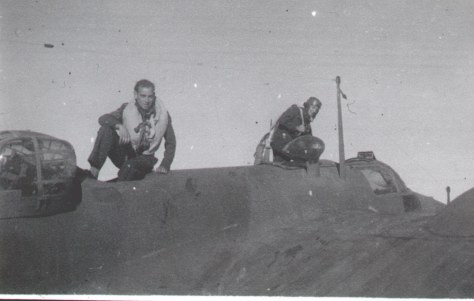
Sgt Jack Barnes -WOp/Ag Sgt Dick Hornby - Navigator aboard their Blenheim V
SOURCE: W/O Jack Barnes
Jack also flew with Canadians, South Africans, New Zealanders & Australians from RAAF 60 squadron. They used to fly from India to advanced airfields in Burma, re-fuel with some 'doubtful' petrol, taken to the fields by pack horse, & attack Japanese interests.
He vividly recalls one raid where they attacked some Jap supply barges on a jetty & after leaving were attacked by Zero's. Several of the flight were shot down & one came up behind him. The Blenheim 4's Achilles heal was that its turret gun couldn't fire dead astern. The guns were mounted close together & would have shot off the tail plane. The Japs seemed to know this & so attacked from behind. Fortunately my father was in a Blenheim 5, newly delivered, which had its guns mounted further apart. This enabled him to place some heavy fire into the attacking fighter, as the bullets pass either side of the tail plane. The fighter peeled off & left them! Upon landing they discovered a hole through a propeller! Close enough!!
His best mate out there was Hughie Courtney, from Chobham in Surrey, who remained as friends, with his family untill his recent death. In August 1943 the 113 Squadron started conversion to a Hurricane fighter Squadron and as this meant that bombers, navigators and air gunners were no longer required, Jack & Hughie were transferred to Delhi to set up 229 Communication squadron. It had no C/O, aircrew, ground crew or anything for a while. At 229 he flew in York's (passenger version of the Lancaster), Dakota's & Hudsons. He says that sounds a bit nicer, but when you were on ops with Blenheims at least they gave you a parachute. When flying non ops with passengers you had no chute. Tour expired with a fantastic "thousand hours" air time, Jack finally made it back home safely in 1945.
NOTE: Jack was contacted several years ago by Anthony Day from Canada who was writing a book about Burma & the Chindits and contributed a piece to it however the book was never published. Tony Day has now been located and has made enormous contributions to the site from his book "Air War Over the Arakan". Tony, Jack & Peter are co-founders of this site.
The above profile on Jack was written by his son Peter Barnes.
NOTE: Considerable more detailed information and many pictures and documents to follow.
S/Ldr Bartholemew
S/Ldr Bartholemew, First squadron leader of 113. Upper Heyford, June 1937 to Apr 1938.
LAC ?? Bass
LAC ?? Bass,
Recorded in S/Ldr Keily's log as having flown with him at Heliopolis in 1939 and Sept 1940
F/O George W Bassingthwaighte DFC 
F/O George Wyndham Nelson Bassingthwaighte, 404619 RAAF Pilot India, Burma Awarded DFC 13/11/1942, page 4927 Gazette pos 4, . . Hilariously nicknamed "B16" because he has 16 letters in his name.
Sgt Keith Hansen noted that in a book by David J Innes who was on a Beaufighter Sqd in Burma, called 27 Sqd Beaufighters over Burma. It States: "One Bristol IV bomber Sqd arrived from Egypt on 7th January and notwithstanding the long flight, nine aircraft took off at 2 am next day to bomb the dock area of the capital of Siam, Bangkok. One of these pilots was Flying Officer Bassingthwaighte, an Australian who later joined 27 Sqd."
F/O Bassingthwaighte who was in charge of A Flight was also known by W/O Jack Barnes and is mentioned in an incident involving a fire extinguisher.
Also Reference Awards 1945 Farewell dinner booklet
Identified by Chapman as being one of the original 18 crews that came out from the Middle East to Burma. Crew on Ops reported to be P/O Bassingthwaighte, Sgt Wally Mckerracher WOp/AG, and F/O Forbes-Gordon Obs.
It was during a raid on shipping in Akyab harbour 09/09/1942 that B-16 and his WOp/Ag won the DFC and DFM respectively.
113 Pilot and Wop/Ag awarded DFC and DFM Gazetted 13/11/1942
Royal Australian Air Force, No. 113 Squadron. As pilot and wireless operator/air gunner respectively Flying Officer Bassingthwaighte and Sergeant McKerracher flew in the leading aircraft of a section of bombers detailed to attack shipping at Akyab. Whilst over the target area, the aircraft was repeatedly attacked by enemy fighters but, in spite of this, Flying Officer Bassingthwaighte executed a most determined attack from a low level. During the engagement Sergeant McKerracher was slightly wounded but he used his gun most effectively. Both these members of air crew have completed numerous sorties and have always displayed fine fighting qualities and great devotion to duty. Distinguished Flying Medal.
Sgt J H Beard
Sgt J H Beard, NZ, born Dunedin, 16 May 1911; furrier.
F/O Leonard Anthony Beauchamp
F/O Leonard Anthony Lasseter Beauchamp ( 401266 ) Born 12 February 1917 in Elsternwick, Victoria. Enlisted 5th January 1941 in Melbourne Victoria. RAAF Observer. Age 25, son of Leonard Lasseter Beauchamp and Helen Fraser Beauchamp of Melbourne Victoria Australia. M.I.A presumed killed 18th June 1942. Middle name Anthony recorded elsewhere as Antony
On the 18th June 1942 F/O Leonard Beauchamp was returning from a raid to Myitkina, the aircraft Z7892 a Blenheim Mk IV piloted by S/Ldr Clifton Harper failed to return. According to official records there was reportedly no WOp/Ag on board, however it has since been determined that F/Sgt Kevan was almost certainly the gunner on this flight. SOURCE: Flight details Graham Warner. Source: Info on F/Sgt Kevan provided by Nick Bracken of Australia who holds F/Sgt Kevan's medal.
J Chapman commented on the loss of this crew in a letter to Tony Day: "On the subject of characters on our Squadron, we had a F/L whose name was Cliff Harper, a Canadian from Toronto. Cliff had done over 100 trips in the Middle and Far East. He was on a detail at Tezpur with Lorne Tapp. When Tapp ran up his kite, it sropped about 200 revs so he would not take it on the raid. Cliff went over to Tapp and said he would take the kite and Tapp could have his. That suited Tapp all right. They took off to bomb Myitkyina and the weather was a real monsoon. Heavy clouds,rain, cu-nim and all the rest. They ran into heavy cloud after bombing the runway at M. trying to get a Jap General who was called "the Tiger of Burma " ( likely means Malaya) They hit the runway, that was all. When Tapp came out of the cloud Cliff was no where to be seen. They later found his kite and body on the side of a mountain; a cloud with a hard centre". Source: F/Lt Tony Day, from research material.
The Orbs state: TEZPUR 18/06/1942 S/Ldr Harper and crew, F/Sgt Tapp and crew, and Sgt Hockney and crew, set off from DINJAN where they refuelled to bomb MYITKYINA. Target was bungalows on the river bank of the supposed H,Q of a Jap General and staff. Owing to very bad weather and 10/10 cloud on way to target, the formation Split and Sgt Hockney returned with engine trouble. F/Sgt Tapp proceeded on his own to the target and on reaching MYITKYINA decided to bomb the aerodrome as there were 4 large twin engined aircraft in it. The bombs fell in a stick at the North East of the runway about 5O yards from the twin engined aircraft. F/Sgt Tapp returned to TEZPUR. S/Ldr Harper who was only seen once after the formation broke up in the clouds was not seen by F/Sgt Tapp over the target and failed to return. S/Ldr C.W.Harper and his Observer P/O A.L. Beauchamp RAAF posted missing as a result of active operations. (Note there is no mention of F/Sgt Kevan, it is unknown why he had not been identified)

F/Lt D. Beauclair
F/Lt D. Beauclair, Nickname "Basher". 11/06/1940 L4823, Mk IV, FTR, shot down by fighters on return from El Adem, F/Lt D Beauclair, Sgt Owen, and LAC (Sgt) J Dobson all injured (burns) and became POW's. (NOTE: Graham Warner has Sgt Owen listed as W/O H. Owen)
On the very same day as the incident 11/06/40 AC2 (Sgt) Bernard Shelton (B Flight) records in his diary the following: "We lost one machine the crew being P/O Beauclair, Sgt Owen and L.A.C. Dobson. Their aircraft landed in flames behind the enemy lines, but all escaped injury. We have since learned that they walked all day towards our lines but were captured. They are now lodged in a hotel at Benghazi." (Recorded at actual time of event).
The following is a greatly abbreviated extract from P/O Shekletons diary for this day: Turned out at dawn. We’re to raid Menistir or if there’s nothing there then El Adem. From 4am. till 6.45 pm. we hang around our aircraft. At last we’re off. Menistir is 150 miles. We fly out to sea...... Barney (S/Ldr Keily) is leading. On ETA we turn in and sweep over the coast. There is Menistir but there’s nothing much there...... Barney turns west and we follow......... here’s El Adem. Bob (Bateson) yells: “Lord, look at ‘em!” I clean forget to be scared. John drops a sitck on the hangars. We follow. A crowd of men on the tarmac (apron) is staring up at us stupidly. John’s bombs burst beside the hangars, mine go through the roofs. On the tarmac are about 30 a/c. I’m sure I miss them and my second stick goes on the field. There’s a ghastly racket under our aircraft (blast from leader’s bombs). We circle and return... Everything is covered in smoke. B Flight’s incendiaries are burning everywhere.
Thompson yells “Fighters!” but I’ve still got bombs. Round we go again and I drop my stick on some buildings. Things are hitting our machine. Bursts of ack-ack smoke are filling the sky. We dive with Bob using the front-gun. It’s a circus. We are down to ten or fifteen feet..... We’re off now streaking toward the sea with fighters on our tail. And there’s ‘Basher’ (Beauclair) burning in front of us. Barney’s shouting. “Join up! Join up!” ‘Basher’s’ going down. Two fighters are attached to us. We hear their guns but we are too fast for them. We’re away. ‘Basher’ has belly-landed.
THE FOLLOWING IS AN EXCERPT GIVING THE ITALIAN PERSPECTIVE: ............Two hours later, at around 07:00 seven more CR.32s scrambled to meet another attack directed on El Adem. Six of the aircraft were from the 94a Squadriglia (Capitano Franco Lavelli, Tenente Giovanni Tadini, Sergente Maggiore Alessandro Ruzzene, Sergente Maggiore Billi, Sergente Maggiore Arturo Cardano and Sergente Maggiore Trento Cecchi while the seventh was from the 92a Squadriglia (CO Martino Zannier). The Italian pilots had a slight height advantage over the seven Blenheims and this made it possible to intercept. The Fiat pilots claimed two bombers shot down (one into the sea and one from which the crew was seen to bale out) and four damaged, all shared among the seven pilots. Zannier returned at 07:40 with the engine on his fighter damaged and having expended 500 rounds of ammunition. The pilots of the 94a Squadriglia landed five minutes later, having spent 3770 rounds of ammunition. SOURCE: http://surfcity.kund.dalnet.se/italy_billi.htm
Recorded in S/Ldr Keily log June 1939
See also Squadron Story, Crews & Losses, P/O Shekleton diary
S/Ldr Ivor Beeston
S/Ldr Ivor Beeston, Service No unknown, RAF, died in the early 1950's. He was born in Tiverton, Devon and grew up at 38 Bampton Street, Tiverton. He learned to fly at a training school in Reading Berkshire. This would have been "Reserve Command" or "Flying Training Command" as it came to be known.
Served in the RAF in Burma and North Africa. According to the Squadron ORB, S/Ldr Beeston and his crew Obo F/O Fraser and Gunner P/O Mills posted in to the 113 Squadron shortly after the disappearance of S/Ldr Cliff Harper.
Mark Annett, who is a nephew of S/Ldr Beeston (Mothers brother) recalls that S/Ldr Beeston was noted in a book he read as a teenager which he believes was "Wings over Burma". (There were two books by this title one by Helsdon in 1984 and another by Hemingway who was a Hurricane Fighter pilot.)
Mark also has a newspaper cutting which mentioned a walk by RAF personnel when Burma was invaded by the Japanese. Ivor Beeston was quoted in the article - they walked for days in the jungle ahead of the invading forces to escape capture.
Hopefully Mark will turn up more info and a photo. He has promised a copy of the newsclipping when he can locate it.
Source: Mark Annett, nephew of S/Ldr Beeston
S/Ldr Beeston and Obo F/O Fraser, Gunner P/O Mills posted in.(Presumably to replace S/Ldr Harper) Extract from Orbs. per F/Lt Tony Day
Note that there is film footage of Ivor in the archives located at the Imperial War Museum in the UK.
ID Number: NPA 1173
Item Name: BRITISH PARAMOUNT NEWS ISSUE 1173 [Main]
Production Date: 28/5/1942
Production Country: GB
Production Company: British Paramount News
F/Sgt Thomas Bell
Sgt Thomas Bell, 402184 RAAF KIA 09/09/1942 Formerly with the 211 squadron. Commorated on panel 118 AWM
09/09/1942 F/Lt Loane piloting Blenheim V6507 Mk? was shot down in a raid with 60 squadron on Akyab, F/Lt O. Loane and crew Sgt Tom (Barney) Barnard Wop/Ag and Sgt Thomas Bell Obo were KIA.
According to J Chapman, this was one of the original 18 crews that left the Middle East for Burma.
F/Lt Bob Bentley
F/Lt Bob Bentley,
Listed in S/Ldr Keily log as having flown with him Apr 1940, also referenced extensively in P/O Shekletons diary. Posted to Rodhesia as training instructor Aug 1940
Sgt Samuel John Bessey
Sgt Sam J Bessey, 648831. Sgt Bessey joined the squadron sometime in April 1940 at the age of 18 at Heliopolis as an AC2. He was one of the very few who remained with the squadron from the beginning untill the breakup in India when the squadron converted to Hurricanes.
Sgt Bessey & friends, May 1940 at Heliopolis
prior to departing to Ma'aten Bagush in the Desert
A few weeks after I arrived on the squadron at Helopolis we moved to Ma'aten Bagush in the Western desert shortly before the conflict with Italy broke out. The C/O had assembled the whole unit for the news, I can't recall the names. One that sticks in my mind was a Sgt Gabard A/C1, he was also in charge of the orderly room ( tent ) and he left me in charge when he was on other duties, me being at the time an A/C2 Plonk. We did occupy orselves with different activities by playing football ( ground staff against Air crew ). I recall we also had the pleasure of hosting the Fleet Air Arm with their Swordfish ( 826 Squadron, May 1941) due to their carrier being damaged. (The 826 was so successfull it returned to Ma'aten Bagush in July providing night illumination flares and support for both the airforce and army) Also I recall our Padre Cox, I was detailed to fly with him and a F/Sgt armourer to the Italian air field in Lybia just South of Tobruk where we duly got shelled on landing from the St Giorgio, the Italian battleship in the harbour. I was sent there to help the Padre bury the dead and also to help the Sgt to look for booby traps which they were very good at. They did drop a load one night on our camp consisting of fountain pens, plates and thermos flasks, anyway being just outside Tobruk when it fell I can say that I was the first airman to enter the town. Everyone converged on the local cinema for loot as this is where the town folk had stored all their posessions before evacuating.
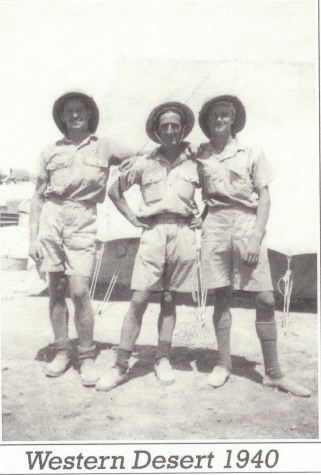
Sgt Sam Bessey (left) middle unknown The one on the right is almost certainly Sgt Shelton
After rejoining the Squadron we were sent way down in the desert arriving at a place called Jerabub, (also called Gerabub, Giarabub, Jaghbub) 150 miles south of Tobruk consisting of a fort occupied by the Foreign Legion and an Army of Khurks. It was to make the enemy think we were attacking them through the back door but as you know the forces just went straight ahead taking the whole of Libya within days. We did get quite a bit of straffing whilst we were at Giarabub and we were all glad to see the back of that area, miles and miles of no where. 33 Squadron with Hurricanes had been our escort squadron. We then made our way back to the Suez Canal area to some place called the Bitter Lakes, I only wish I could name all the places we passsed through. We were now wondering what was in store for being a mobile Squadron.
The next thing I remember we were on board a ship heading for Greece, according to Lord Haw Haw, the German Air Force sunk the biggest part of our convoy. They did manage to hit the ship next to us which was a fuel tanker, the last I saw of it, the whole ship was ablaze from stem to stern. Upon landing in Greece, we had some hair raising travelling heading North to our destination near Mount Olympus. It must have rained for about two weeks with the aircraft waiting to go on a raid, then one day the sun came out and the sky went black with German bombers and fighters. They simply wiped us out and at the end of the day it was simply a case of looking out for oneself in the vocation of getting back to the area of Athens. In a book I have there is a picture of lorry loads of 113 personnel passing through Athens, most of whom I recognize including myself. 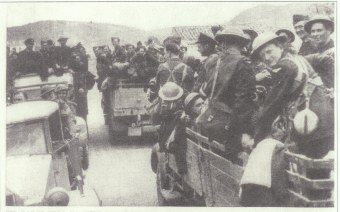 My pal Cyril Wickham and I got orders to help an RAF Officer with his gear onto a plane, a Bomby*, and during loading we were fired on by a German sniper. We managed to get away and the next thing we knew we were landing on Crete.
*SEE NOTE
Cyril Wickham & Sgt Sam Bessey enjoying
some R&R after return from Greece TelAviv 1941
Not long after, a few days perhaps, the Germans landed in Crete. So, off we go again landing in Egypt, we finally re-joined our 113 in Palestine. After a bit of a rest and a weeks holidays in Tel-a-viv we once again found ourselves on the desert. (1941) In the photo sent, I recall the camp by the building among the tents, we used it as Mess, also the NAAFI. I recall we also had visitors of fighter planes giving us a good straffing.
Later, we once again found ourselves aboard ship, The City Of Paris. After being at sea for a day we were informed that we were on our way to Port Darwin in Australia but owing to the fall of Singapore we finished up in 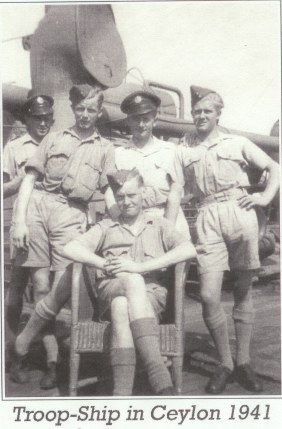
Rangoon - all the Air Crew ( having arrived much earlier in Burma by plane) they finished up in Northern Burma. ( Sgt Bessey & others enroute to join the aircrew arrived just as the Japs were invading Rangoon & were immediately turned around ) Our boat then had to make a dash back to India with no escort. We all had jobs looking for Jap subs and we lost a few personnel through Yellow Fever, quite a few sea burials.
Anyway, I finally got back to the squadron stationed at a place called Asansol. One thing I recall here was two pilots returning from a raid over Burma showing off to see who could fly the nearest to the building and one of them clipped a cross on top. (This was an American nick named Tex, Ffolliett Foster)
SGT SAM J BESSEY 648831
2004
I wonder what todays Servicemen would say if they had to put up with say, three or four years away from home going through several campaigns under the conditions we had to put up with. (They simply couldn't do it Sam, very few could )
Salome, Home for batchy airmen,
We call on to sing us a song
We have been in this desert too Bloody long
Pilot Sgt John Reid The “BOMBY” aircraft would be a Bristol Bombay troop carrier. Corp Bessey and I were on the same ship but did not meet.
Sgt George Biggins
Sgt George Kenneth Biggins, (550227) KIA Age 21, Son of George and Alice Biggins of Mexborough Yorkshire. Commemorated Alamein Libya. His brother Walter was also killed on service. Sgt Biggins had been with the 113 Squadron possibly from the beginning and is recorded in S/Ldr Keily's log as having flown with him in March 1939 when he was a Corporal and again May 1940
29/06/1940 FTR from bombing raid to El Gubbi. L8447, Blenheim Mk 1, flown by 31-year-old Flying Officer Walter R. P. K Mason (RAF no. 70450) was shot down in flames Italian fighters. Crew: F/O Walter Mason and Sgt J. Juggins also killed in action.
Two other Blenheims, L8522 and L8436 were also lost on this raid.
Note that Sgt George Biggins had been incorrectly identified as J Biggins by Graham Warner,
At sunrise on 29 June nine Blenheims bombed the airfield of Tobruk T2. Three CR.32s of 93a Squadriglia, 8o Gruppo, 2o Stormo C.T. and three CR.42s of 77a Squadriglia, 13o Gruppo, 2o Stormo C.T. scrambled under the falling bombs to intercept them. Tenente Giulio Torresi of 77a Squadriglia reached the bombers at six-o'-clock and attacked the last Blenheim which, after three strafes, caught fire and fell. Then, avoiding defensive fire, he attacked another bomber and shot it down. Sottotenente Gian Mario Zuccarini of 93 Squadriglia and Sergente Maggiore Fausti shared a third Blenheim and then, following the formation out over the open sea, they claimed another two, one each. Another Blenheim was shared by the other pilots, which damaged two more.
Torresi, Zuccarini (who was wounded in a leg) and Fausti were all awarded with the Medaglia d'argento al valore militare after this combat.
NOTE: The above is presented as found.
Sources: http://www.dalnet.se
Sgt Arthur Birley
Sgt Arthur Birley
It is known Sgt Birley was on detachment to Loiwing China. Details as follows: On April 10, 16, 21 1942 flights were detached and sent to Loewing China. On the 21st a flight of six Blenheims led by W/Cdr Grey were sent, these listed in order of pilot, Obs, Wop/Ag were (Wcdr Grey, Sgt Barry, Sgt Tollett) & (F/O Hammond, P/O Evans, Sgt Lord) & (P/O Griffiths, Sgt Davies, Sgt Dicketts) & (F/Sgt Hinds, F/Sgt Aitken, Sgt Bailes) & (F/Sgt Symondson, Sgt Birley, Sgt Woodcock) & (Sgt Webster, Sgt Whyte, Sgt Cheshire) SOURCE: Sgt Alan Bailes
CLICK ON NAME FOR PERSONAL PAGE
S/Ldr, John Ian Blair. Corporal, Arm/AG / Acting Sgt while he was with the 113 squadron, approx 1939 to Sept 1940. Joined the RAF as a boy entrant and trained as an armourer, 1134. Trained & qualified in the UK as a A/G in 1936. Posted to 113 with rank of AC-1 Arm/AG from the date of embarkation from Grantham in April 1938. He was classified as aircrew and flew operationally as Acting Sgt (unpaid) Cpl Arm/AG. At the time Cator was the C.O and the Flight Commander was F/Lt Dallamore.
In Sept 1940 113 Ground Crew (acting Observer) Corporal Ian Blair, a non-pilot safely landed the plane he was in after his pilot (P/O John Harry Reynolds, nickname Mouse) was shot. Ian was awarded the DFM for the incident and left the squadron to take pilot training. To read the whole story of this incredible event, see his personal page by clicking on his name above. It can also be read in the True Tall Tales Section.
NOTE: This event is often confused with a very similar event that took place in 1941 (?) when F/Sgt Clement (Bush) Barrey Obo, although a non-pilot, took the controls and flew his aircraft (Blenheim) back to base after his pilot was ejected/jumped from the aircraft during a storm. He also eventually retrained as a pilot. Contrary to popular belief he was not on the squadron at the time of the event and was not awarded the DFM for this incident, but had been awarded the DFM while on the 113 squadron for services above & beyond the call of duty in Aug/Sept 1941.
Asked about the colour of the squadrons Blenheims, Ian states they were sandy brown on top and robins egg blue underneath. He Flew with S/Ldr Keily once. Ian remebers having to refill Blenheims by hand using four gallon cans and recalls it was hot dirty work requiring that they be lifted to wing height, a funnel was used with a chammy leather in top and the tank required 400 gallons to fill. Thats 100 cans, one egyptian chap helping on the squadron could carry 8 cans at once Ian recalled. the empty tins were often used to patch up bullet holes and repairs along the wings leading edge.
Recorded in S/Ldr Keily log Aug 1940
LAC?? Blackshaw
LAC ?? Blackshaw,
Listed in S/Ldr Keily log as having flown with him July 1940
Lt J. S. Bowker WW1
Lt J.S. Bowker,
Served with the 8th Bn, Manchester Regiment, receiving his commission to the rank of 2nd lieutenant on the 23rd Spetember 1915 (23/09/1915). He is believed to have transferred into the 113 Squadron in January 1918 at Sarona and thus served from beginning to end of Gen Allenby's second offensive to drive the Turk's completely out of Palestine. In all he served in the Middle East from about mid September 1917 to early 1919 and received a Mention In Despatches issued by Allenby.
F/Sgt ?? Brenan
F/Sgt Brenan,
Listed in S/Ldr Keily log as having flown with him July 1940
Sgt Kenneth William Brett
Sgt Kenneth William Brett 402123, RNZAF Killed in action 04/03/1942 at age 26. Honoured on the Singapore War Memorial. (Nickname Schnoz)
04/03/1942 * Magwe 1500hrs F/Lt Lee and crew, Sgt Kenneth Brett (0), Sgt Lister Walker (G) with three crews from 45 Squadron carried out a bombing attack in the Sittang river area. F/Lt Lee was flying in No 4 position. The formation was flying at approx 1,500 feet when attacked by enemy fighters, believed to be Navy "O" type. F/Lt Lee left the formation and dived to ultra low level in an attempt to escape but was attacked by four enemy aircraft, three astern and one in front. The pilot was hit by a bullet and the aircraft crashed west of the Sittang River, and 60 miles east of Pegu.
The gunner, Sgt Lister Walker, climbed out and the pilot attempted to do the same but was fatally shot and fell back into the cockpit which was by then afire. The gunner attempted to pull F/Lt Lee out from the cockpit thinking he was wounded, but as the bullet wound was in the head he realized it was fatal. He then looked for Sgt Brett the Observer, whom he found 50 yards from the nose of the aircraft, dead, with his head smashed in. Sgt Walker was then obliged to shelter under the tail of the aircraft while the four enemy aircraft made four strafing attacks. Later hearing artillery fire to the N.E. he walked in the opposite direction & after two days with friendly Burmans arrived at Thamatpin, approx 15 miles east of Pegu. Reporting to Capt. Ince of the Burma Rifles, Sgt Walker was given transport to Army Brigade HQ and thence to Rangoon, ultimately reporting to 113 Squadron. The aircraft was completely burnt out.
SOURCE: extract from the ORB's. PRO reference AIR27/878 per the above. Extract obtained from Charlie Walker, son of Sgt Lister Walker.
Sgt Lister Walker and pal Ken Brett (Shnoz)
03/05/1941
F/Lt G. Brew
F/Lt G. Brew
23/06/1943 BA607 Mk V Aircraft hit the sea for reasons unknown and crash landed on beach. FLt G. Brew , (pilot) uninjured. F/Sgt W. Facton (Obs) injured.
Known to have been on the 10/11/1942 shipping strike on Akyab. Crew on this op was F/L Bassingthwaighte, F/O Forbes - Gordon
SOURCE: Air War Over The Arakan, Author Tony Day
CLICK ON NAME FOR PERSONAL PAGE
F/Sgt Gerard Brigden, RAF Fighter Pilot, Hurricane and Thunderbolt, Burma theater.
Although I volunteered as a Pilot in the RAF in 1941, I was not enlisted until December 1942. The delay was due to the fact that I had to have an operation on my nose which had been broken during a cricket match at school when a ball unexpectedly jumped up as I bent down to field it.
After a brief six weeks of induction and *fitting out" in the U.K. I was sent with approximately half of the Unit, by passenger liner, from Southampton to Durban in S. Africa. (The other half of the Unit went for training in Canada.) Our journey to S Africa took about four weeks. From Durban we travelled by rail to Bulawayo in what was then Southern Rhodesia and is now Zimbabwe. We arrived in Bulawayo in March, 1943.
March - September, 1943
We had extensive theoretical training at a camp just outside Bulawayo , in Air Navigation; Meteorology; Advanced Mathematics; Engine and Flight Functions; and RAF Administration and Organisation. We then travelled by rail to Salisbury, the capital of S. Rhodesia.
September - 15th November, 1943
Flight training on Tiger - Moths (Bi-plane.)
22nd November - 18th April, 1944
Flight training on Harvards (Mono-plane.)
21st April, 1944
Awarded "Wings" and qualified to wear "Flight Badge.
23rd April - 9th May, 1944
Travelled up through Africa by lorries, then by boat across the Great lakes, then by lorries again to Kisumu in Kenya. From there we went by air to Cairo.
21st June - 17th August, 1944
Commenced operational training on Hurricanes, at Ismaelia, N.E. of Cairo.
September - Mid-October, 1944
Jungle Training at Poona, India.
18th October- 18th December, 1944
Advanced Operational Training on Hurricanes Mark 2, at Ranchi, Bihar Province, India.
Group photo at conclusion of advanced training at Ranchy Bihar, India 1944.
P/O G. Brigden seated second from left and third from left is John Skelly I believe.
Photo includes Engineers and Ground Crew
SOURCE: F/Sgt Gerard Brigden Collection
Again at Ranchy Bihar, India 1944
Gerard Brigden, Tony DeWitt, John Skelley
SOURCE: F/Sgt Gerard Brigden
From 17th January, 1945
Commenced Operational Bombing/Strafing flights against Japanese positions in the Irrawaddy area. Subsequently we supported the army as they advanced down Burma, operating from airstrips that were bulldozed out of suitable terrain. This was then laid with perforated metal sheets to make runways.
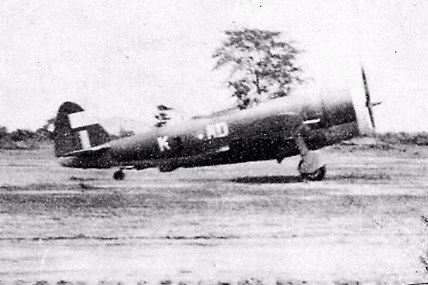
F/Sgt Gerard Brigden in his P47 Thunderbolt K - AD about to take off
from an airstrip at Meiktila, 1945
SOURCE: P/OGerard Brigden
In all, I made 32 operational sorties. One very memorable sortie was the bombing of the walls of Mandalay, to enable the army to make an effective entry into the town which was occupied by the Japanese.
On July 15th, 1945, ( 15/07/1945 ) we converted to U.S. Thunderbolts Mark 2. Although it was a much more complicated aircraft there was no training given for this conversion. We were just given information about the take-off and landing speeds. As the minimum landing speed of the Thunderbolts was 120 mph compared to the 70 - 80 mph of the Hurricanes, there was a lot of rubber burnt up on our short airstrip on our first take-off and landing exercise. Hardly surprising considering the aircraft was also heavier than a Blenheim bomber, however, the whole squadron managed it without mishap. One of the distinct advantages the Thunderbolt had was a 4hr flight time compared to 1 1/2 hr of a Hurricane.
During this time I made a number of reconnaissance flights down the peninsula joining Burma to Malaya where the Japanese were still holding out.
My last operational flight was on 11th September, 1945 ( 11/09/1945 ) - the day before the Japanese surrendered, However, up to the 2nd September we were flying into remote areas in the peninsula between Burma and Malaya, distributing leaflets confirming the surrender of the Japanese, and locating P.O.W. camps along the Bangkok - Moulmein Railway - line.
Following this we were assigned to a number of different localities. A small group of us were assigned to the Cocos Islands where there was an aerodrome still being used as an intermediate refuelling base for flights between Australia and Ceylon. I believe that it was in January 1946 that direct flights between Ceylon and Darwin were inaugurated and the Cocos Islands base was thus no longer needed. A ship arrived later in the month upon which the whole unit boarded and were "shipped" back to the U.K.
TIMELINE
16/01/1945 Joined the squadron at Onbauk. The commanding officer at the time was Sq/Ldr Rose and the Flight Commander was F/Lt Slinger.
17/01/1945 Practised formation flights and sector reconnaissance flights.
21/01/1945 First operational flight in a Hurricane Mk 2 which consisted of the bombing and strafing of Monywa.
22/01/1945 to 30/01/1945 Continued to attack Japanese positions in the Monywa Irrawadi area and log book lists 13 sorties during this period. Desired results were achieved with the Japanese being pushed further south.
23/02/1945 Squadron moves to new airstrip at Ondaw further south in pursuit of the retreating Japanese. Bombing and strafing of Japanese positions continues and includes the walls of Fort Dufferin in Mandalay where the Japanese were holding out.
10/07/1945 Squadron again moves to a new airstrip at Meiktila where American Thunderbolt 2 aircraft had been flown in.
15/07/1945 First solo flight in a Thunderbolt (Note this is only 5 days after being introduced to this advanced fighter aircraft)
15/07/1945 to 08/08/1945 Squadron practices formation and reconnaissance flights.
13/08/1945 First operational flight in a Thunderbolt.
02/09/1945 Started to deliver surrender leaflets to remote areas.
11/09/1945 Last operational flight lasting 3.5 hrs flying along the Bangkok Moulmein Railway line to photograph and identify prisoner of war camps the Japanese had established in order to construct the notorious Burma railway.
During the war years I became increasingly convinced that after the war I should, if possible, devote my time to constructive and creative activities. I did, in fact, train and become an Architect, working for much of my time in undeveloped countries - with the constant help and support of my wife, Eve, who participated in many local activities.
NOTE: Not surprisingly, Gerard being an architect whose buildings can be found the world over, is also a talented painter and is currently doing some watercolours of the Squadron in action. See below, and also the STORES ROOM
Gerard is an active Co-Founder of the 113 web site and has played a key role in it's development from the beginning. Both a good friend and deeply committed to this project, he has been a source of numerous ideas and much inspiration throughout. My profoundest thanks to his wife Eve who has patiently allowed me to drag Gerard away from other things I am sure she would rather he expended his energies on.
Sgt Douglas Eric Briggs
Sgt Douglas Eric Briggs, No 759058 RAF Gunner. WOP/AG, Son of Arthur and Sarah Briggs of Maidenhead, Berks. KIA 24/01/1942 buried with his crew mates in the Kanchanburi Cemetery Coll, Gr. 10, M, 10-12
On 24/01/1942, Z7582 MKIV FTR from a raid on Bangkok, Sgt Percy Keeley - pilot, Sgt Dingle - Obo, Sgt Douglas Briggs - WOp/Ag all KIA.
A night raid was made on Bangkok, all serviceable aircraft participating. The Blenheims attacked singly at ten-minute intervals, bombing from 2000 feet with a war load of four 250 lb. bombs and four 25 lb. incendiaries. Large explosions and several fires resulted. An intense anti-aircraft barrage was again encountered over the target area, and two aircraft, including Sergeant Briggs, failed to return.
Sgt J E Chapman in correspondence with Author F/Lt Tony Day stated: "they were killed on the second raid on Bangkok on the 27th. Hit by fire from a Jap gunboat, the aircraft burst into flames as it hit the ground killing the crew instantly. Note: date discrepancy and how the aircraft was brought down, it is not certain yet which is correct.
One of the original 18 crews that came out from the Middle East to Burma.
W/O Keith Mortimer Bright
W/O Keith Mortimer Bright 426496 06/11/1944
Click on Name For Personal Page
F/Sgt Ewan Brooking 401454 RNZAF. Navigator/Bomber. Born Auckland, 31 Jan 1922, died 07 Feb 2007. Joined RNZAF 04/06/1940. Training Course #9. Promoted F/Sgt effective 01/09/1941.
Sgt.Harry Duignan and Sgt. Ewan Brooking, both observers (Nav/B) of the Royal New Zealand Air Force were posted to 113 Squadron R.A.F. on 10/03/1941 from the Middle East Pool at Geneifa, to Kabrit were the Squadron was based.
Sgt Brooking left Kabrit on the 12th by truck convoy , by way of Suez for Cairo enroute to Amiriya. On the 15th they went by train from Amiriya Station, and were taken by rail to the docks in Alexandria. There we boarded the " S.S. Queen Adelaide", a small tramp steamer enroute to Greece.
On the 1st. of April he was temporarily crewed up with P/O Pengelly, and flew in a Blenheim from Menidi airfield [near Tatoi ] to Larissa. After landing they were informed that due to damage from recent earth the aerodrome was unserviceable for taxi-ing so on the 3rd they took off for Niamata, an airfield 10 minutes to the East of Larissa.
On Tuesday the 22nd the Luftwaffe struck the aerodrome in a prolonged devastating attack which wiped out all of their aircraft and they were soon ordered to evacuate. After a harrowing journey lasting days, and often under fire, they arrived at an orchard outside Nauplia. Later In the early evening they were assembled and marched in column a few Kilometers to Nauplia, where a Commando Landing Ship {the Glenairn ? } had arrived to evacuate them from Greece.
After arriving in Crete they were trucked nearly the full length of the North coast to the airfield at Heraklion. On the 29th of April Sgt Brooking was one of the lucky ones able to fly out of Crete in a Lockheed Lodestar headed to Egypt. After a two hour flight they landed at Maaten Bagush, in Egypt and the long ordeal was finally over.
Sgt Ewan Brooking far right, W/O Bernard (Dick) Allen center, left unknown.
Source Sgt Ewan Brooking
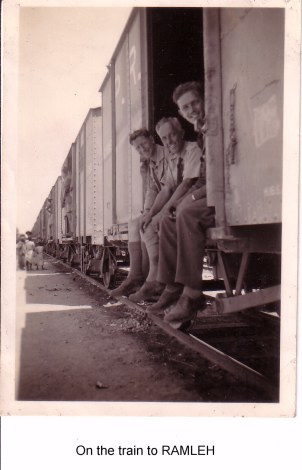
The next move was to Ramleh, in Palestine to an empty Army camp where the squadron was to be re-formed and re-equiped. Given their recent ordeal, leave was granted freely & Sgt Brooking used his time to visit some of the Biblical sites in the area. Late in May, having now re-equiped, they received orders that we were moving to Egypt, to the Western Desert battlefront. For some members of the Squadron it was .........Back To The Desert.
On 1st June 1941, the Squadron arrived back in the desert. We were to be stationed at L.G.15, otherwise known as Bir Zimla or Sidi Haneish. The airfield was up on the escarpment above the railway line with the Station of Sidi Haneish below us, and was classed as a satellite of Maaten Bagush. My 1 hr 20 minutes in Greece was evidentaly considered enough Operation Training for me to be Crewed up for Operational Flying. I considered myself lucky in that my pilot was to be an experienced Rhodesian in the R.A.F.,F/LT Stidolph. The gunner was a R.A.F. Sgt. Bill Smith. Operations throughout this period were straffing the costal road and bombing of enemy aerodromes and ports. One operation of note was an attack on Bengazhi harbour 29/08/1941. Take off was at 1610 for the 45 min. flight in Z6233 to Sidi Barrani for fuel. Over the harbour they were hit in the port wing fuel tank with a cannon shell, out of fuel and with a landing wheel shot away they made a harrowing landing at Sidi Barrani.
Following his return to Bir Zimla from leave at Tel Aviv on the 20th Sept he crewed up with P/O Cashmore an R.A.A.F. pilot, to take the place of Wally Kilgour, R.N.Z.A.F., another Ob. from his course. He had gone down with Yellow Jaundice. The Gunner was Sgt.Ken Woods. R.A.F. We were to go on detachment to Malta, consisting of four Fighter Blenheims and 5 crews to be the outer ring of defence for an important Convoy sailing to Malta. While they were here, they carried out sub patrols, attacks on E boats and in one case an attack on Italian Destroyer or Cruiser off Trapani. During the attack Squadron Leader Ford was hit and he and crew were taken out of action. The following day Sgt Crossley & crew were lost and on the 30th Sept the three remaining Blenheims returned to base.
Sometime later in September (?) the airfield was straffed by M.E. 110's. firstly attacking Sidi Haneish station, and then coming onto the aerodrome killing one airman. Small bombs were also dropped by the 110's. Later during night bombing practice on the 22nd of Sept. two Blenheims crashed making practice low-level bombing runs on the L.G. One taxied into a slit trench, and the other went too low and crashed. The pilot F/O Doug F Brooks was killed and the Obo broke both legs.
A sampling of the Ops for October include: 01/10/1941 was the first, a night-fighter patrol in T1823 with P/O Cashmore. Take-off at 2040, for 1hr20. The radio wasn't working properly so we couldn't hear the Ground Controllers directions. Next was a night raid on the 07/10/1941 on Bardia in T2117 with S/L Lydall. Take-off at 0235 for 3hr 35. On the 09/10/1941, in V 5436 with S/L Lydall a strat. and photo recco. of Gialo, Augila, and El Haseiat. Take-off at 0655 for 6hr 05. Next on 12/10/1941 a night raid on a Jetty in Bardia Harbour, in T2393 with S/L Lydall, Take-off at 0240 for 3hr 25. On the 13/10/1941 another night raid on a Submarine in Bardia Harbour in 6134. Take-off at 0137 for 4hr25, with S/L Lydall. The sub. was supposed to be resting on the sea bed and the bombs fell where they were supposed to, but no results were observed. The last for October and the last till January 1942, was a bombing raid on Gabr Ssleh, with S/L Lydall in V5841, for 2hr45. This was to be carried out with cloud cover, but there was not even a wisp of cloud, so this raid was aborted.
On the 20th October Sgt Brooking was posted to Tomahawk House in Alexandria on rest leave where he met Sgts. Tapp, Clarihue, and Chapman of the R.C.A.F. This well earned rest lasted untill the 4th of December.
Sgt George Checketts and Sgt Ewan Brooking enjoying a well
earned beer. I doubt it was cold but it was wet, undoubtedly it
tasted like the nectar of the gods compared to the water.
Source: Sgt Ewan Brooking
Fortunately for Ewan the Squadron moved up to Giarabub while he was gone and he was spared this fiasco. Returning on the 6th December 1941 the Squadron base was now at L.G 116 which was South of the old base at Bir Zimla, but the operational base was at L.G.76. This was South of Siddi Barrani. On the 9th word came through that they were being moved off the desert, not where to or why and on the 19/12/1941 came the move back to Helwan (Heluan), with an overnight stop at Burg El Arab. No planes, just the personnel, in truck convoy, arriving at Heluan on the 20th, and being billeted in the Transit Camp. On the 22/12/1941 was crewed up with Lt. Viney S.A.A.F. and Sgt.Jack Wohlers R.A.A.F. Then on the 23/12/1941 they collected the first 8 planes.These were fairly new Mk 4 Blenheims that had been assembled at Takorati on the East coast of Africa, and flown across the continent. The one brought from Fayoum to Helwan by Sgt Brooking was Z9674.
On the 30th. the first 6 planes left just after 9am.with the C.O.leading, for the long haul to India and beyond. On the 1st. of January 1942, another 5 planes left with F/L Duggan-Smith leading.The sixth plane was u/s. On the 5th we started on our long flight to Bangkok, Burma, or Bust.
The following is only a snapshot of the full story, please click on Sgt Brookings name above for more photos and a highly detailed full account which covers all of 113's theaters, Greece, Egypt, Malta, Burma, India.
See also History Section - Squadron Story, The Time Line, Photo Section
Sgt Brooking is one of the founders of the 113 Squadron Web Site.
Sgt ?? Brooks
Sgt Brooks RAAF (45 Squadron ?)
Known to have been on the 10/11/1942 shipping strike on Akyab. Crew on this op was Pilot Lt Gus Alder and F/O Corbett.
SOURCE: W/O Jack Barnes
Note also F/Lt Tony Day records F/O Corbett as posted in from 45 Sqd on 27/10/1942 and back out on 22/11/1942
F/O Douglas Foulsham Brooks
F/O Douglas Foulsham Brooks, 42299, United Kingdom, Flying Officer (Obs.) Age: 25 Killed 22/09/1941, Son of Alfred Foulsham Brooks and Dorothy Joan Brooks, of Cheam, Surrey. Grave/Memorial Reference: XXIX. F. 2. EL ALAMEIN WAR CEMETERY
On the 22nd of Sept F/O Brooks was conducting night bombing practice. An F.A.A. Albacore dropped flares over the landing ground with two Blenheims making practice low-level bombing runs on the L.G. During the exercise one taxied into a slit trench, and the other went too low and crashed. The pilot F/O Brooks was killed and the Ob. received two broken legs. The names of the other crew members are unknown as is the serial of the aircraft.
This brief visit of the Canadians and their FAA Swordfish with the 113 squadron in the desert is well documented and many 113 members have fond memories of their visit. These night training exercises that led to F/O Brooks death, although very dangerous to even the most veteran pilots, were of great value in assisting the 8th Army and directly contributed to saving hundreds of soldiers lives.
In March 1941 826 Squadron (Canadian) Fleet Air Arm flying Swordfish took part in the Battle of Matapan and damaged the Italian battleship Vittorio Veneto by torpedo, subsequently taking part in operations against Tripoli and Bardia. In May 1941, when their ship was badly damaged after raids against Scarpanto island, the squadron disembarked to Dekheila and then Fuka and then Maaten Bagush in the Western Desert. In July operations from Nicosia, Cyprus, were made against Vichy French ships at Beirut, followed by a return to Maaten Bagush to support the 8th Army, where it provided night illumination flares for the 7th Cruiser squadron. Operations were so successful that the squadron then carried out these duties for the army and Desert Air Force as well as attacking enemy harbours and shipping strikes. Although the article can not be re-located the Source of info on 826 is believed to be www.fleetairarm.com
Source: CWGC and Sgt Ewan Brooking
Corp ?? Brown
Corp ?? Brown,
Listed in S/Ldr Keily log as having flown with him June 1939
P/O ?? Bruce
P/O Bruce,
Known to have been on the 10/11/1942 shipping strike on Akyab. Crew on this op was S/Ldr Penny, Sgt Barclay
SOURCE: W/O Jack Barnes
Note that both S/Ldr Penney and P/O Bruce were ex 45 Squadron, posted in 02/05/1942 (source ORBS - Tony Day)
(CLICK ON NAME FOR PERSONAL PAGE)
W/O John Bott, Pilot - Blenheims, Hurricanes. Burma 1942 -1945
John remained in good health untill he died in 2005 shortly after making contact with some of his old friends for the first time since the war.
Trained - unknown
Promoted P/O about July 44
Promoted W/O 1945
When I joined the 113 from X1 we were both stationed with our Blenheims at a place ESE Calcutta, I think it was about 40 miles up the road. The sister X1 squadron who had an Aussie W/Cdr borrowed my Nav and then disappeared with him over Chittagong or Akyab. Very soon after this we (113) moved to St Thomas, Mount Madras in southern India to begin retraining from a bomber to a fighter squadron. Our Navs & Air gunners which would not be required anymore joined 2 seat "so called dive-bombers" called Vengeancers which I think were seconded to the Indian air force, it was all a shamble. At the St Thomas, Mt Madras airfield we were converted through Harvards to Hurricanes. 146 Squadron did the conversion. I was known on the 113 for being a bit unruly in speech & behaviour after the grog we managed to get from the local native quarters. As a NCO I rose to the dizzy rank of Warrant Officer but then did most, it was done on time.
One incident I recall while we were there was a huge dam broke and we awoke to be floating in our charpoys and rising fast. We eventually had to climb on the roof of our basher and watch the water rise. The rats we saw were bigger then cats. The rise slowed down and a few of my mates swam under water into the officers mess and stole a whole load of grog. (Editors note: this missing bar stock from the officers mess is recorded in the official squadron records, the officers believing it had been lost in the flood) We then strode off when we could into a hotel room in Madras and drank our illicit grog. There was of course hell to pay, but the few of us who were missing were rounded up and we were on our way to Bangalore to finish the conversion on an airfield called Cholavarum. The mind is a bit blank but after that we all moved by train up to the Naga Hills to a place with a runway called Dimapur. Here we slept on bamboo beds in bashas surrounded by stone shapes in the form of the male anatomy.
Up in Assam we were. From that strip, we the squadron became operational on Dec 4th 1943 ( 04/12/1943 ). At this time we had a C/O called Buck Courtney and his younger brother Pat had joined us. Could not stand Pat on the squadron, but in civvy life, he was a great friend when in 92 I nearly died of an Aorta Aneurysm but that is another story. My wonderful flight commander was a chap by the name of Ken Rolls "who sadly is no more." Also Buck & Pat are no longer around.
Our Sorties were over the Eastern Hills and down to straffing sampans and things supplying the Nips. On one ocassion Ronny Lockwood and I were scrambled to locate a Nip at about 30 000 ft and I hit a Vulture on take off but we pressed on in the faint hope of sighting the intruder. We did not make contact but I remember seeing another Vulture as we passed 15 000 ft. Of course I lost Ronny and he landed at Imphal while I came down on the strip at Palel "which was to mean a lot to the 113 later on." The Vulture had done some damage to my port wing so the ground crew at Palel mended it and I was off back to the (male anatomy) aerodrome at Dimapur. On arrival Buck Courtney tore a strip off me for loosing Ronny.
After awhile the nips cut the main supply line at Kohima "where the famous battle was won and the nips gave up their intention of invading India through use of the railway line which began at Dimpur." 113 moved to Palel via Jorhat and Tulihal and Silcharwest. We then operated from Pathakandi for awhile, flying down to a strip called Tulihall each day in the Imphal Valley and back to Pathakandi, but when the Kohima road was finally opened we landed up at Palel via other airfields on the way.
Palel was a strip almost surrounded by Jap forces and they lobbed a few shells at us one night and destroyed at least two of our aircraft, I remember that the Flight Sergeant Bill Lockerbie (in charge of our ground staff) was furiously annoyed that a Jap used his office for a washroom. Palel was the scene each day of shooting up the enemy attacking our soldiers in 17 Div. One day I spotted a tank and radioed the base and they through HQ scrambled the Indian Air force with tank buster Hurricanes. I was to show them where the tank had been and we flew out to the area but they screwed it all up and fired a few bursts at our own soldiers, I screamed at them and then was directed to land at Imphal and see Wing Commander of Operations. He met me as I climbed out of my Hurricane and told me he believed my story, and that I was in the clear and to rejoin the 113 at Palel. I think the offenders were the 14 squadron (Indian) but I never heard anymore about the incident.
(Editors note: It is woth noting that a similar mistake took place on Feb 20 1942 ( 20/02/1942 ) when unidentified Blenheims attacked retreating columns of the British 17 division and caused very heavy casualties. The poor chaps from the 17th must have been as fearfull of seeing the RAF comming as the enemy.)
Most of us did 3 or 4 Sorties a day assisting 17 division but there came a time in June 44 when our targets were up towards the Kohima area where the army was beginning to push the Japs back towards Burma.
On June 6th, 1944 ( 06/06/1944 ) I boobed when I reckoned my Flight Commander Aussy Frost (S/Ldr Ernest Frost) was bombing too far right of the so called target and with my No #2 we banked around and had another go. Pulling out of my dive I heard and felt a bang and my Merlin engine petered out. Flying dead stick at low level I had no time to choose suitable ground, and hoping for the best, made a crash landing in about 10ft of grass. The Japs were firing at me and..... well.... the rest is another story. I got back by exceptional good luck in about 2 1/2 days. A very lucky escape and I still find it uncomfortable to bring it back to mind.
I had two weeks off and my great Aussy friend Creamy Ryall and I applied for some sort of course which meant going to Kasmir up the Zochila pass to learn how to survive in uncomfortable surroundings and ski a bit. The real reason we went was to sample the only beer brewed in India and that we did to extreme measures. The tramping up the pass to the plain at the top was 14 thousand feet and no grog up there. When the snow started that year it was not too long before our instructors got the "wind up" and we hurtled downwards before we were cut off. We made it back to Murray where the beer is brewed and via a couple of race courses we made it back to Delhi from where we could bludge a lift on a Dakota or something to get back to Calcutta.
In this posh Delhi Hotel where the so called Rahz hung out, we kidded a turbaned senior waiter to serve us afternoon tea in a huge teapot full of Murray beer. I think we had perhaps a refill or two and shocked the Rahz who obviously by then knew what the score was. We looked after the waiter who was only doing his job for the white men in RAF and RAAF uniforms. Perhaps his children or great grand children still have a chuckle.
We eventually arrived back at Palel and were confronted with a new C/O S/Ldr Rose. I had by then become a pilot officer.
Referenced / picture in F/O Pat Woodward book page 15 & 16.
??? Paddy Bowe
??? Paddy Bowe, Reference 1945 Farewell dinner booklet.
P/O ?? Buchanon
P/O ?? Buchanon,
Listed in S/Ldr Keily log as having flown with him April 1939
F/O Tom Burleigh
F/O Tom Burleigh, Canadian, pilot on Hurricanes, Burma. Reference by F/Lt Stanley Chilton DFC. Tom and Stan exchanged letters and Tom stayed with Stan during the early 1980's when the 113 reunions were held in London UK. In the photo I have of one of the reunions Tom is speaker and proposing a toast. Tom served in Malta in 1942 while it was still under seige and would often talk about his experiences. He died, sadly, not long after the photos were taken.
Sgt Maurice Kennedy Burnside
Sgt Maurice Kennedy Burnside, 400188 RAAF. Born 1918, died 1978.
Saw active service in Egypt, Sudan (including Khartoum) and Libya. Served with 113, 211, 11 and 55 Squadrons RAF, flying Blenheim and Baltimore aircraft
NOTE: Source of above as well as the log, pictures and files of Maurice are on file and copies can be obtained from the Australian War Memorial Web site. The following are the particulars.
D Number: PR00491
Title: Burnside, Maurie Kennedy (Sergeant b: 1918 d: 1978)
Maker: Burnside, Maurie Kennedy
Object type: Papers
Date made: 1940-1948
Measurements: 11 items
Summary: Papers include navigator's notes and logbook, photo album, certificates and diaries. Material relates to training with RAAF in Australia and active service in Egypt, Sudan (including Khartoum) and Libya. Diaries describe serving with 113, 211, 11 and 55 Squadrons RAF, flying Blenheim and Baltimore aircraft, bombing raids, German attacks, crash landings and injuries.
Copyright: External copyright
Copying provisions: Copying permitted subject to physical condition
Access: Open
Sgt Ken Burrows
Sgt Ken Burrows, RAF, Gunner. Crew on Ops were F/Sgt Joe Ward, Pilot RCAF and Sgt Bill Lewis, Navigator. Flew the MkV Bisley.
F/Sgt Ward arrived on 113 Sqd in April 1943 when the Squadron was based at Chandina near Comilla, possibly Sgt Lewis and Sgt Burrows did as well.
SOURCE: Research notes of Tony Day and excerpts of book Air War Over The Arakan
NOTE: Joe Ward not to be confused with Les Ward 113 Sqd KIA June 1943 or Bill Ward who was 60 Sqd.
ACH Charles Buttle
ACH Charles Buttle,
Friend of Sgt Bernard Shelton, The following is extracted from his diary: Cleaning and servicing the machine. I will take this opportunity to describe the occupants of the tent and our mode of living.
There are in the tent. Cpl. "Mac" McClellan, "Charlie" Buttle, "Pincher" Martin, "Dutch" Taylor, "Pig" Malyon, "Tubby" McKinley, "Balloon" Berridge, and of course myself - the "Chicko". Quite a merry crew who don't care what happens as long as they have their beer. We are slowly getting organised with household utensils.
Tuesday June 18th 1940
Quite an easy day today. Nothing of importance to report. Dutch and Charlie went on a reptile hunt. One chameleon, one snake and a few scorpions. The rest of us sat still and got rid of some more beer.
Listed in S/Ldr Keily log as having flown with him June 1939
Sgt Frederick Lloyd Butcher
Sgt Frederick Lloyd Butcher, RCAF. Attended No 5 B&G school at Dafoe Saskatoon.
On 08/07/1942 Sgt Butcher, on a Reece over the Gangaw area piloting Blenheim Z6155 was unable to climb out of a blind valley in bad weather and crash landed near Fort White, Burma. F/Sgt F. Butcher broke his back in the crash and his crew Sgt John Kirkpatrick Obo and Sgt Steel A/G were also injured. After the crash he was returned to Canada where he became a Staff Pilot at a B&G School. He was later killed in a Bolingbroke in a flying accident on the 24 May 1944 (24/05/1944)
According to a family member Roy, the story handed down was that Sgt Butcher lost an engine close to the field coming back from an exercise. He did not catch the swing in time and the aircraft went into a spin. Lloyd had the aircraft out of the spin but was still trying to pull out of the dive when the aircraft ploughed into the ground at about a 45 degree angle. Lloyd and the trainees on the aircraft were killed immediately.
His Observer was John A Kirkpatrick , likely also RCAF. F/Lt Tony Day visited him while he was living in Vancouver in 1989. He states that their A/G was a Sgt. Steel RAF but no further information.
Pilot Sgt. John Reid recalls the valley trap which caught Butcher: I saw that blind valley that caused Butcher to belly land on the slope. The Japs were causing problems to the UK troops at Fort White. On 7/7/42 operating from Tezpur, we were briefed to do a bombing raid (single aircraft) on Kalemyo and then do an offensive low level recco with strafing of the Kalewa Road and then the road to Fort White, situated in the foothills of the main range. As we turned around a bend in the road there was an inviting valley with the same road in the distance climbing to Fort White. Peter Wilson (Obs) shouted “Watch it, its too narrow”. I also could see the danger so we turned tail and got out of it before returning to Tezpur. We reported this trap on de-briefing and I cannot help but wonder if it was passed on to Butcher, who got trapped in the same valley the next day, 8/7/42. It could have been so easy to get into an impossible situation with the steep ridges on either side of the valley preventing even a steep turn to get out, the rising ground ahead being too high to climb over even on full throttle.
SOURCE: F/Lt Tony Day research notes & excerpts of Air War Over The Arakan.
Roy, relation to Sgt Butcher. Roy conversation with Tony.
LAC ?? Byling
LAC ?? Byling,
Listed in S/Ldr Keily log as having flown with him Apr 1940